

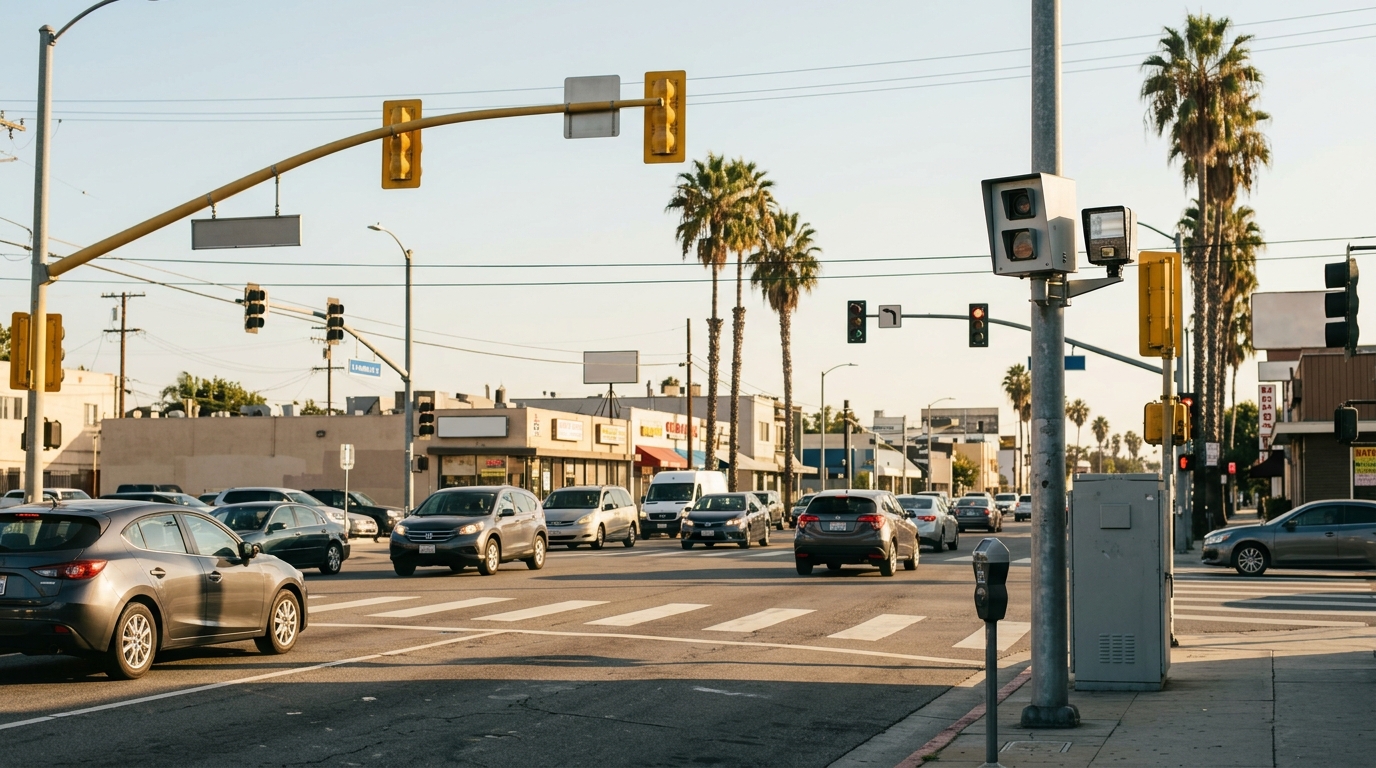
California red-light camera accident claims in 2026 have become more relevant following the passage of Senate Bill 720. Effective January 1, 2026, the legislation allows eligible local jurisdictions to use an alternative automated traffic enforcement system for red-light violations. The law introduces a civil enforcement framework while establishing requirements involving cameras, notices, privacy, and penalties.
For people injured in intersection collisions, the change raises important questions. Can a red-light camera help identify what happened? Does a violation prove a driver was negligent? Can an insurance company use camera information when investigating fault? The answers depend on the facts of the crash and the availability of legally obtainable evidence.
Red-light collisions can cause devastating injuries. A vehicle entering an intersection against a traffic signal may strike another automobile from the side, injure pedestrians, or create a multi-vehicle crash. High-impact collisions can result in fractures, traumatic brain injuries, internal injuries, and long-term rehabilitation needs.
However, an automated traffic citation is not the same as a complete personal injury investigation. The camera may establish certain facts about a vehicle’s movement without identifying every cause of the accident.
This guide explains how California’s updated red-light camera framework works, how evidence may affect injury claims, and what accident victims should understand before relying on automated enforcement records.
What Changed Under California’s Red-Light Camera Law in 2026?
Senate Bill 720 created an additional legal framework for automated enforcement at qualifying intersections. The legislation allows eligible jurisdictions to operate camera programs under conditions established by California Vehicle Code Section 21455.9.
The program differs from traditional traffic enforcement because qualifying violations are handled through civil penalties rather than ordinary criminal traffic citations. The statute also includes safeguards addressing notice procedures, privacy, equipment operation, and administrative review.
Importantly, SB 720 does not mean every California intersection now has an automated camera. Local governments must establish programs according to the law’s requirements. Drivers should not assume a camera exists at a particular intersection without confirming that information.
The law is primarily an enforcement measure. It does not automatically change the legal elements of negligence, causation, or damages in a personal injury lawsuit.
How automated red-light enforcement programs operate
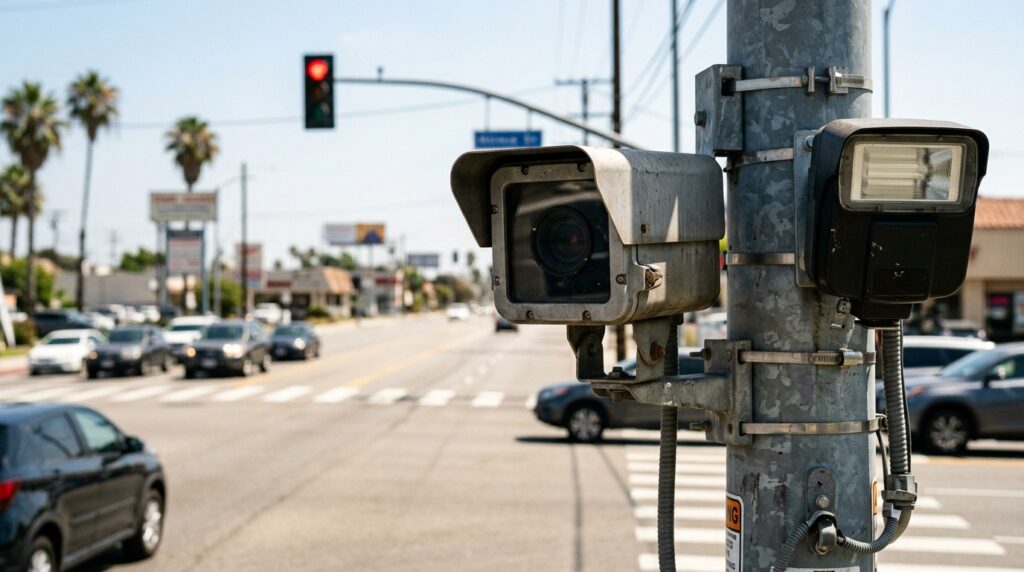
Automated enforcement systems use equipment designed to detect qualifying traffic signal violations. Depending on the authorized program, the system can record information about a vehicle entering an intersection after a traffic signal changes.
The evidence may include images of a vehicle’s rear license plate, the intersection, the relevant signal, and the timing of the alleged violation.
California’s new framework places emphasis on collecting information necessary for enforcement while limiting unnecessary identification of drivers and other road users.
A camera notice is generally directed through the procedures established for the registered owner. However, the identity of the registered owner and the identity of the person driving during a collision are not necessarily the same.
That distinction becomes important in civil injury cases, where investigators may need to identify the actual driver responsible for the collision.
Why civil penalties differ from traditional traffic tickets
Under the SB 720 framework, qualifying violations are subject to civil penalties. This differs from traditional moving violations that may carry driver’s license points or criminal traffic consequences.
The legislation generally establishes a $100 civil penalty for qualifying violations under its alternative enforcement program, subject to the statute’s provisions and administrative procedures.
Other requirements govern notices, payment procedures, review rights, and protections for eligible low-income individuals.
These enforcement rules should not be confused with the damages recoverable in a personal injury lawsuit. A civil traffic penalty is not compensation paid to an injured accident victim.
Similarly, payment of a penalty does not automatically determine whether a person was negligent in a separate collision.
Privacy restrictions can affect access to camera evidence
One important feature of the 2026 framework involves the treatment of recorded information. The law contains restrictions addressing camera placement, collection of identifying information, confidentiality, and use of automated enforcement records.
These safeguards protect privacy, but they also mean injured people should not assume that all camera footage is publicly available.
Some records may be exempt from ordinary public disclosure procedures. Access to relevant material may depend on the statute, applicable evidentiary rules, authorized recipients, and legal processes.
A person injured at an intersection should identify potential camera systems promptly. However, obtaining useful recordings may require investigation beyond submitting a standard public records request.
Other sources, such as business surveillance footage, dashboard cameras, and witness recordings, may be more accessible in a particular case.
Can a red-light camera violation help prove fault?
A traffic signal violation can be relevant to a negligence claim, but it is not necessarily conclusive. California Evidence Code Section 669 establishes circumstances in which violating a qualifying safety statute may support a presumption of negligence.
The analysis also considers whether the violation caused the injury and whether the statute was intended to protect against the type of harm involved.
For example, if a driver enters an intersection against a red signal and strikes another vehicle traveling with a green signal, investigators may examine whether the violation contributed to the collision.
However, questions can remain about signal timing, driver identity, visibility, speed, and the actions of other motorists.
The absence of a camera citation does not necessarily prove that a driver obeyed the signal. Cameras may not exist, may not have recorded the event, or may have limited coverage.
Why signal timing and driver behavior still matter
Accident reconstruction often involves more than identifying which light was red. Investigators may examine when vehicles entered the intersection, their approximate speeds, road conditions, and whether drivers reacted to visible hazards.
A driver who entered legally may still have relevant duties concerning speed and attention. Another driver may have been distracted, impaired, or traveling too quickly to respond appropriately.
California generally follows comparative negligence principles. More than one person’s conduct may contribute to an accident, and damages can be affected by the allocation of responsibility.
Our article on California distracted driving accident claims in 2026 explains how phone use, navigation activity, and digital evidence can become relevant when investigating driver attention.
How to Protect an Injury Claim After a California Red-Light Collision
The first priority after a serious intersection accident is safety and medical care. Call emergency services when injuries or dangerous conditions require immediate assistance.
People with head injuries, severe pain, breathing problems, weakness, or other concerning symptoms should receive appropriate medical evaluation.
Once the situation is safe, photographs and witness information can help preserve details that may disappear when traffic resumes.
Useful photographs include vehicle positions, traffic signals, lane markings, skid marks, debris, nearby cameras, and roadway conditions.
Drivers should avoid making unsupported assumptions about fault before investigators have reviewed the available evidence.
Evidence, insurance coverage, and legal deadlines

A red-light collision investigation may involve police reports, witness statements, dashcam recordings, vehicle damage patterns, and electronic data from involved automobiles.
Some vehicles contain event data recorders that preserve selected information about speed, braking, or other systems during qualifying crash events.
These records do not provide a complete explanation of every collision. Their usefulness depends on the vehicle, recorded parameters, crash circumstances, and lawful access to the information.
Surveillance video may also be important. Businesses sometimes overwrite recordings after a limited retention period, making early identification and appropriate preservation requests valuable.
Medical records help document injuries and their consequences. Treatment notes, imaging results, rehabilitation records, and employment documentation may become relevant when evaluating damages.
What if the responsible driver has limited insurance?
California’s minimum automobile liability insurance requirements increased in January 2025. The standard minimum limits are $30,000 for bodily injury or death to one person, $60,000 for bodily injury or death to more than one person in an accident, and $15,000 for property damage.
These minimum amounts may be inadequate after a severe side-impact collision involving multiple injured people.
Depending on the facts and policies, additional coverage may be available through other responsible parties or applicable uninsured or underinsured motorist insurance.
However, insurance policy limits and the legal value of an injury claim are different matters. The existence of a traffic citation does not automatically determine compensation.
Victims should preserve medical bills, lost-income information, repair estimates, receipts, and relevant communications with insurers.
For background on serious collision investigations, our California wrong-way accident and collision evidence articles explain how driver conduct and electronic records may affect complex claims.
Our article about 2026 pedestrian safety ratings also discusses how vehicle design and crash data may help investigators understand the severity of injuries involving vulnerable road users.
California Code of Civil Procedure Section 335.1 generally establishes a two-year limitations period for many personal injury lawsuits. Exceptions may apply, and government-related claims can involve much shorter administrative deadlines.
Prompt action may also help preserve evidence. Camera footage, vehicle data, witness memories, and physical accident details can become harder to obtain over time.
Victims should not assume that an insurance investigation will automatically collect every relevant recording. The availability of footage and lawful procedures for preserving it should be considered early.
For the official description of the 2026 change, readers can consult the California DMV’s summary of new laws taking effect in 2026.
The important distinction is that automated enforcement supports traffic-law compliance, while an injury claim requires a separate legal analysis.
A useful camera record may help explain a vehicle’s position and signal timing. It may not prove who was driving, identify every contributing factor, or establish the full extent of an injured person’s damages.
For drivers, prevention remains essential. Approach intersections at an appropriate speed, avoid distractions, maintain awareness of pedestrians, and never accelerate simply to beat a changing traffic signal.
Drivers should also understand that a green signal does not eliminate the need to watch for vehicles or people already within an intersection.
California red-light camera accident claims in 2026 illustrate the growing relationship between traffic enforcement technology and personal injury evidence.
SB 720 creates another framework for addressing red-light violations, but its presence does not replace police investigations, accident reconstruction, medical documentation, or insurance analysis.
When an intersection collision causes significant injuries, careful preservation of available evidence and an accurate understanding of California law can help clarify the circumstances and potential claims.
Disclaimer: This article provides general educational information and does not constitute legal advice. Liability, insurance coverage, evidence access, and filing deadlines depend on the facts and applicable law.